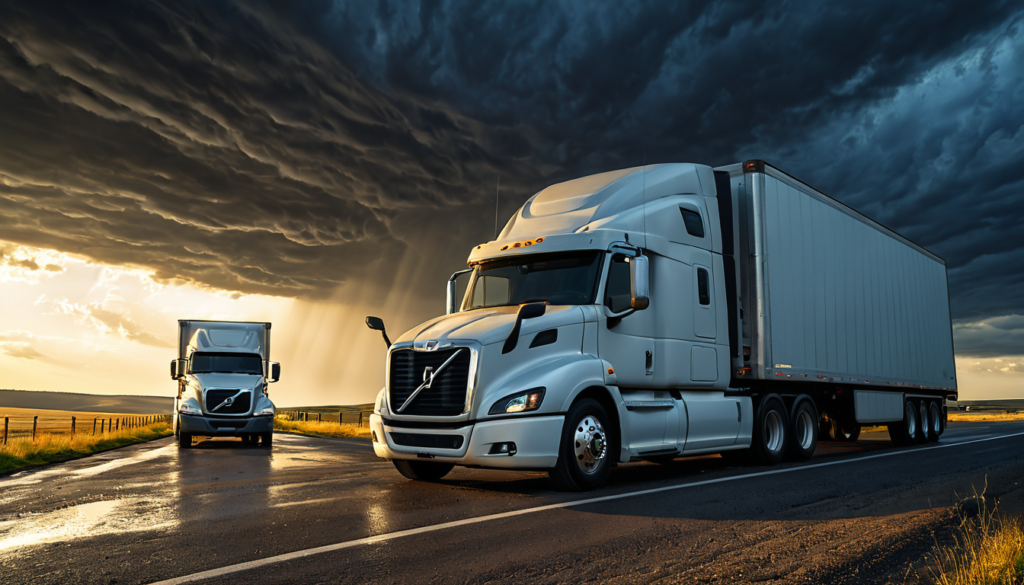
18-Wheeler Accident Attorneys in Elk County, Kansas
When 80,000 Pounds Changes Everything
One moment, you’re driving home on a Kansas highway. The next, an 80,000-pound semi-truck is jackknifing across your lane. In Elk County, where harvest season brings hundreds of grain haulers to our roads and I-35 traffic barrels through just miles from our borders, these accidents aren’t statistics—they’re life-changing realities for local families.
We’ve seen it happen too many times. A wheat truck blows a tire on US-160. A fatigued driver falls asleep on the long stretch toward Oklahoma. A poorly loaded trailer rolls over on a rural county road. Unlike regular car crashes, 18-wheeler accidents involve massive forces, complex federal regulations, and trucking companies that move fast to protect their profits—not your family.
At Attorney911, we don’t let them get away with it. Ralph Manginello has spent over 25 years fighting for accident victims across the Midwest. Our team includes a former insurance defense attorney—Lupe Peña—who used to work for the very companies we’re now battling. He knows their playbook. That insider knowledge, combined with our federal court experience and track record of multi-million dollar verdicts, means we can handle the complexity your case demands.
If you’ve been hurt in a trucking accident anywhere in Elk County, the clock is already ticking. Evidence disappears fast. Black box data can be overwritten in 30 days. And the trucking company already has lawyers working to minimize your claim. Call us immediately at 1-888-ATTY-911 for a free consultation. We work on contingency—you pay nothing unless we win.
Why 18-Wheeler Accidents Are Different in Elk County
The Physics Don’t Forgive
Your average sedan weighs about 3,000 pounds. A fully loaded 18-wheeler tips the scales at 80,000 pounds—that’s more than 25 times heavier. When that mass hits a passenger vehicle at highway speeds, the results are catastrophic.
But it’s not just the weight. It’s the stopping distance. A truck traveling at 65 miles per hour needs nearly 525 feet to stop—about the length of two football fields. On Elk County’s rural highways, where reaction time is everything and cell service can be spotty, that distance becomes deadly.
Harvest Season Hazards
Elk County sits in the heart of Kansas wheat country. From June through July, our roads flood with grain trucks during harvest season. These aren’t professional long-haul drivers—they’re seasonal operators pushing tight schedules. Overloaded trailers, inexperienced drivers on narrow county roads, and pressure to get crops to market create a perfect storm of danger.
FMCSA regulations still apply to these agricultural haulers, but enforcement can lag during peak season. When a grain truck jackknifes on K-99 or rolls over on a county road near Howard, the injuries are often catastrophic.
Weather Conditions That Kill
Kansas isn’t gentle. We’re in Tornado Alley, where severe thunderstorms can spawn deadly twisters with little warning. Winter brings ice storms and blizzards that turn I-35 into a skating rink. High winds—constant across the plains—can blow high-profile trailers off the road or into oncoming lanes.
Trucking companies know these conditions. Federal law requires them to train drivers for adverse weather. When they fail, and a driver loses control on black ice near the Oklahoma border, that’s negligence—and we hold them accountable.
Federal Regulations That Protect You
The FMCSA Safety Net
The Federal Motor Carrier Safety Administration (FMCSA) governs every commercial truck on American roads. These aren’t suggestions—they’re federal laws with criminal and civil penalties for violations. When we investigate your Elk County accident, we subpoena records to prove exactly which regulations were broken.
49 CFR Part 390: General Applicability
This section establishes who must follow federal trucking laws. Any vehicle with a Gross Vehicle Weight Rating (GVWR) over 10,001 pounds engaged in interstate commerce falls under federal jurisdiction. Most 18-wheelers operating in Elk County qualify easily, giving us federal leverage in your case.
49 CFR Part 391: Driver Qualification Standards
Trucking companies cannot let just anyone drive. Drivers must be at least 21 years old for interstate commerce, possess a valid Commercial Driver’s License (CDL), pass a Department of Transportation (DOT) physical exam every two years, and maintain a Driver Qualification (DQ) File with complete employment and medical histories.
We see violations constantly. Drivers operating with expired medical certifications. Companies that failed to verify previous employment or check driving records. In one recent case near the Elk County line, we discovered a driver had three previous preventable accidents that the carrier never bothered to investigate during hiring. That’s negligent hiring, and it makes the company directly liable for your damages.
49 CFR Part 392: Driving of Commercial Motor Vehicles
This section covers operating rules. Drivers cannot operate while impaired by fatigue, drugs, or alcohol. They must obey traffic laws, maintain safe following distances, and never read, write, or use handheld mobile devices while driving.
49 CFR Part 393: Parts and Accessories Necessary for Safe Operations
Brakes. Lights. Tires. Cargo securement. Every component must meet strict standards. Cargo must be secured to withstand 0.8g deceleration forward, 0.5g acceleration rearward, and 0.5g lateral forces (side-to-side). When a load shifts on a curve near Moline, causing a rollover that crushes a sedan, we prove the trucking company violated these securement rules.
49 CFR Part 395: Hours of Service (HOS)
This is where we find the smoking gun in most fatigue-related accidents. Federal law strictly limits driving time:
- Maximum 11 hours driving after 10 consecutive hours off-duty
- Cannot drive beyond the 14th consecutive hour after coming on duty
- Must take a 30-minute break after 8 cumulative hours of driving
- Weekly limits: 60 hours in 7 days or 70 hours in 8 days
Since December 2017, most trucks must use Electronic Logging Devices (ELDs) that record these hours automatically. This data is objective, tamper-resistant, and often proves drivers exceeded legal limits—sometimes at the direct instruction of dispatchers pushing impossible delivery schedules.
ELD data gets overwritten in as little as 30 days. That’s why you can’t wait. Call 1-888-ATTY-911 immediately so we can send spoliation letters today to preserve this critical evidence.
49 CFR Part 396: Inspection, Repair, and Maintenance
Trucking companies must systematically inspect and maintain their fleet. Pre-trip and post-trip inspections are mandatory. Brake systems must meet specific adjustment standards. Tires must have minimum tread depths (4/32″ for steer tires, 2/32″ for others).
We recently handled a case where post-crash inspection revealed the truck’s brakes were so poorly maintained they barely functioned. The driver had noted the deficiency in his inspection report weeks earlier, but the company never repaired them. That deliberate indifference to safety warrants punitive damages.
The Accidents We See in Elk County
Jackknife Accidents
When a truck’s cab and trailer fold together like a pocket knife, the trailer often sweeps across multiple lanes—or the entire roadway on narrow Kansas highways. These accidents typically happen when drivers brake improperly on wet or icy roads, or when empty trailers (common after grain delivery) lose traction.
The physics are brutal. A 53-foot trailer swinging at a 90-degree angle creates a steel barrier that smaller vehicles cannot avoid. Injuries include traumatic brain injuries, spinal cord damage, and crushing deaths.
Rollover Crashes
Kansas highways feature long, flat stretches, but Elk County also has rolling terrain. When a truck takes a curve too fast—especially when loaded top-heavy with grain or equipment—the center of gravity shifts. 50% of rollover crashes result from failure to adjust speed on curves.
Rollovers are particularly deadly on rural roads where guardrails are sparse and vehicles can slide into ditches or collide with oncoming traffic. We investigate whether cargo was properly secured and whether the driver was trained to handle Kansas’s specific highway geometry.
Underride Collisions
Perhaps the most horrific truck accidents involve underride—when a passenger vehicle slides under the trailer. The trailer height often aligns with a car’s windshield, resulting in decapitation or catastrophic head trauma.
Federal law requires rear impact guards (49 CFR 393.86) on most trailers, but these guards sometimes fail or are poorly maintained. Side underride guards aren’t required federally yet, though some carriers voluntarily install them. When we investigate underride deaths in Elk County, we examine guard integrity, lighting visibility, and whether the truck stopped suddenly without adequate warning.
Rear-End Collisions
You’re stopped at a red light on US-160, waiting to turn toward Howard. Behind you, an 18-wheeler approaches. The driver doesn’t see you in time. The impact propels your vehicle into the intersection—or worse, under the truck ahead.
Because trucks need 525+ feet to stop from highway speeds, following distance violations (49 CFR 392.11) are deadly. Dashcam footage and ECM data often show the driver never braked until impact, proving distraction or fatigue.
Tire Blowouts
The summer heat on Kansas highways can reach 100°F+. Combined with overloaded trailers (common during harvest) and poor maintenance, tires overheat and explode. A “road gator”—the shredded tire carcass—can strike following vehicles, or the driver may lose control completely.
We investigate tire age, inflation records, and load weights. If the truck exceeded weight ratings or used retreads against manufacturer recommendations, that’s evidence of negligence.
Cargo Spills and Hazmat
Elk County sees petroleum transport and agricultural chemicals. When tankers roll over or cargo spills, the results include fires, chemical burns, and environmental contamination. These cases involve additional federal regulations (49 CFR Part 397 for hazardous materials) and often attract federal investigators from the National Transportation Safety Board (NTSB).
Every Party That Could Owe You Money
Trucking accidents differ from car crashes because multiple parties share liability. We pursue them all to maximize your recovery.
The Driver
Individual drivers are liable for negligent operation—speeding, distraction, fatigue, or impairment. We examine cell phone records, drug test results, and driving histories.
The Trucking Company (Motor Carrier)
Under respondeat superior, employers are liable for their employees’ negligence. But we also pursue direct negligence claims:
- Negligent Hiring: Failing to verify CDL status, driving records, or previous accident history
- Negligent Training: Inadequate preparation for Kansas weather conditions, mountain driving (if applicable), or cargo securement
- Negligent Supervision: Ignoring ELD violations, failed drug tests, or safety complaints
- Negligent Maintenance: Knowingly operating trucks with defective brakes, tires, or steering systems
Commercial carriers carry substantial insurance—typically $750,000 to $1,000,000 minimum, with many holding $5,000,000+ in coverage for hazmat transport.
The Cargo Owner/Shipper
When grain elevators or agricultural co-ops overload trucks or demand unrealistic delivery schedules that force HOS violations, they become liable. We examine loading records and contracts.
Third-Party Loaders
If a separate company loaded the cargo improperly—unbalanced weight, insufficient tiedowns, or exceeding weight ratings—we name them as defendants.
Maintenance Companies
Third-party mechanics who performed negligent repairs or missed critical safety issues bear responsibility. We subpoena work orders and inspection reports.
Truck and Parts Manufacturers
Defective brakes, defective tires, or design flaws in the cab structure can trigger product liability claims against manufacturers. These cases require expert testimony but can yield substantial settlements.
Freight Brokers
Brokers who arrange transportation but don’t own trucks must exercise reasonable care in selecting carriers. If they knowingly hired a carrier with poor safety records or inadequate insurance, they’re liable.
Government Entities
While rare, sometimes poor road design, inadequate signage, or failure to maintain highways contributes to accidents. Claims against Kansas DOT or local counties must meet strict notice requirements—usually within six months—so speed is critical.
Your Injuries and Your Future
The Real Cost of Catastrophic Harm
Trucking accidents don’t just cause “car accidents.” They cause life-altering medical conditions requiring millions in lifetime care.
Traumatic Brain Injuries (TBI)
Concussions, coup-contrecoup injuries, and diffuse axonal injuries occur when the brain impacts the skull during violent truck collisions. Symptoms may not appear for days—confusion, memory loss, personality changes, chronic headaches.
Moderate to severe TBI cases typically settle between $1,548,000 and $9,838,000 depending on the need for lifelong cognitive therapy and loss of earning capacity.
Spinal Cord Injuries and Paralysis
The force of a truck impact can fracture vertebrae, severing the spinal cord. Paraplegia (loss of leg function) and quadriplegia (loss of all limb function) require wheelchairs, home modifications, and 24/7 care.
These cases often command $4,770,000 to $25,880,000 to cover lifetime medical expenses, lost wages, and pain and suffering.
Amputations
Some crush injuries are so severe that limbs cannot be saved. When trucks pin victims or rollover accidents cause compartment syndrome, surgeons must amputate. Beyond the initial trauma, victims need prosthetics ($50,000+ each), replacement every few years, physical therapy, and psychological counseling.
Amputation cases typically range from $1,945,000 to $8,630,000.
Wrongful Death
When trucking negligence kills your loved one, Kansas law allows recovery for lost income, loss of companionship, mental anguish, and funeral expenses. Recent settlements in similar cases range from $1,910,000 to $9,520,000, with higher amounts available when gross negligence—like knowingly employing a drug-impaired driver—is proven.
Burn Injuries and Internal Trauma
Fuel fires and chemical spills cause third-degree burns requiring skin grafts and years of reconstructive surgery. Internal bleeding from crushed organs may require emergency surgery and affect victims for life.
Kansas Law and Your Rights
Time Limits That Can End Your Case
Kansas gives you two years from the date of the accident to file a personal injury lawsuit. For wrongful death, the clock starts running from the date of death, not the accident. Miss this deadline, and you lose your rights forever—regardless of how severe your injuries or how clear the trucking company’s fault.
But waiting is dangerous for other reasons. As mentioned, ECM data overwrites quickly. Witnesses move away. Memories fade. We need to investigate immediately.
Comparative Fault in Kansas
Kansas uses a “modified comparative negligence” system with a 50% bar rule. This means you can recover damages if you’re found less than 50% at fault for the accident. If you’re 30% responsible, your award is reduced by 30%. But if you’re 51% at fault, you recover nothing—not even medical bills.
Trucking companies and their insurers love to blame victims. “You were speeding.” “You braked suddenly.” “You were in the truck’s blind spot.” We counter these arguments with hard data—ECM records, ELD logs, and accident reconstruction proving the driver and company’s primary responsibility.
Our 48-Hour Evidence Preservation Protocol
Why We Move Fast
Within hours of an accident, trucking companies deploy “rapid response teams”—investigators, lawyers, and insurance adjusters—to the scene. Their job is to protect the company, not to help you.
We’ve seen evidence disappear. Logs get “lost.” Trucks get repaired before inspection. Drivers are coached to give false statements. Some companies even destroy black box data deliberately, gambling that victims won’t know to demand preservation.
We don’t give them the chance.
The Spoliation Letter
Within 24 hours of retaining us, we send formal spoliation letters to every potentially liable party—the driver, trucking company, maintenance shop, and insurer. These letters put them on legal notice that:
- Litigation is anticipated
- All evidence must be preserved
- Destruction of evidence constitutes spoliation, which can result in court sanctions, adverse inference instructions (the jury is told to assume destroyed evidence was damaging to the defense), or default judgment
This letter demands preservation of:
- ECM/EDR data (speed, braking, throttle position)
- ELD records (hours of service, GPS location)
- Driver Qualification Files (employment applications, medical certificates, training records)
- Maintenance and inspection records
- Dashcam footage
- Dispatch records and communications
- Cell phone records
- The physical truck and trailer (before repair)
Expert Investigation
We retain accident reconstruction engineers, human factors experts, and medical specialists who can explain complex trucking mechanics to a jury. We download black box data before it disappears. We analyze cargo loading manifests. We investigate the trucking company’s safety history using FMCSA’s Safety Measurement System (SMS) data.
As client Glenda Walker told us after we recovered her settlement, “They fought for me to get every dime I deserved.” That doesn’t happen by accident. It happens because we do the work others won’t.
Frequently Asked Questions About Elk County Trucking Accidents
Do I really need a lawyer, or can I handle this myself?
You can represent yourself. You can also perform surgery on yourself, but we don’t recommend it. Trucking companies have teams of lawyers and millions in insurance. They know every trick to minimize your claim—delaying negotiations until you’re desperate, recording statements they can twist, disputing obvious liability.
Statistics show that represented clients receive significantly higher settlements even after attorney fees. At Attorney911, we work on contingency—you pay nothing unless we win. There’s no risk to getting professional help, but there’s enormous risk in going it alone.
How much is my case worth?
Every case is unique. Factors include injury severity, medical expenses (past and future), lost wages, pain and suffering, and available insurance coverage. In Kansas, trucking companies must carry at least $750,000 in liability coverage, with many carrying $1-5 million.
We’ve recovered $5 million+ for a traumatic brain injury victim, $3.8 million for an amputation case, and $2.5 million for a trucking crash victim. Currently, we’re litigating a $10 million hazing lawsuit against the University of Houston, demonstrating our ability to handle high-stakes, complex litigation.
What if the truck driver was an independent contractor, not an employee?
Even if the driver was an owner-operator, the trucking company may still be liable under theories of negligent hiring, supervision, or if they exercised sufficient control over the driver’s operations. We investigate the actual working relationship—who owned the trailer, who scheduled routes, who demanded delivery times. Often, “independent contractor” status is challenged successfully in court.
Can I recover damages if I was partially at fault?
Yes, in Kansas, as long as you were less than 50% at fault. Your award is reduced by your percentage of responsibility. So if you’re awarded $100,000 but found 20% at fault, you receive $80,000.
How long will my case take?
Simple cases with clear liability and moderate injuries might settle in 6-12 months. Complex cases involving catastrophic injuries, multiple defendants, or disputed liability can take 18-36 months. We work to resolve cases efficiently while maximizing value—never rushing to a low settlement just to close the file.
As client Angel Walle noted, “They solved in a couple of months what others did nothing about in two years.” Sometimes efficiency comes from knowing exactly what evidence to gather and how to pressure the insurance company effectively.
What should I do immediately after the accident?
- Call 911 and request police
- Seek immediate medical attention (even if you feel “fine”—adrenaline masks serious injuries)
- Take photos of everything: vehicles, license plates, road conditions, your injuries
- Get the truck’s DOT number and driver information
- Get witness contact information
- Do NOT give recorded statements to any insurance company
- Call Attorney911 immediately
What if I don’t have health insurance?
Don’t let that stop you from getting treatment. We work with medical providers who treat personal injury clients on a Letter of Protection (LOP)—meaning they get paid when your case settles. Your health comes first; we’ll handle the financial arrangements.
Will my case go to trial?
Probably not. Over 95% of personal injury cases settle before trial. However, we prepare every case as if it’s going to trial. Insurance companies know which lawyers are willing to go to court, and they offer better settlements to those firms. We’re not afraid of the courtroom—Ralph Manginello has been admitted to the U.S. District Court for the Southern District of Texas, giving us federal jurisdiction for interstate trucking cases affecting Elk County residents.
How do I pay for a lawyer?
You don’t pay us upfront. We work on a contingency fee basis: 33.33% if settled before trial, 40% if we go to trial. If we don’t win, you owe us nothing. We also advance all costs for investigation, experts, and litigation. You focus on healing; we focus on winning.
Do you speak Spanish?
Sí. Hablamos Español. Our associate attorney Lupe Peña is fluent in Spanish and provides direct representation without interpreters. If you or your family members are more comfortable discussing your case in Spanish, call 1-888-ATTY-911 and ask for Lupe Peña.
Why Elk County Families Choose Attorney911
Deep Experience
Ralph Manginello has been fighting for injury victims since 1998. He’s been featured on KHOU 11, ABC13 Houston, and in the Houston Chronicle for his work on major cases, including the recent $10 million University of hazing lawsuit and his involvement in the BP Texas City Refinery explosion litigation that resulted in over $2.1 billion in settlements industry-wide.
Insider Knowledge
Lupe Peña spent years working for a national insurance defense firm. He knows exactly how trucking insurers evaluate claims, train their adjusters to minimize payouts, and when they’re bluffing about low settlement offers. He now uses that knowledge against them to maximize your recovery.
Proven Results
We’ve recovered over $50 million for our clients across all practice areas. That includes multi-million dollar settlements for traumatic brain injuries, amputations, and wrongful death—precisely the catastrophic injuries common in 18-wheeler accidents.
Available 24/7
Trucking accidents don’t happen during business hours. Neither does our availability. Call 1-888-288-9911 anytime. We’re also available via email at ralph@atty911.com or lupe@atty911.com.
Three Offices, Local Reach
While our roots are in Texas with offices in Houston, Austin, and Beaumont, we handle trucking accident cases nationwide. For Elk County residents, this means you get the resources of a firm that’s battled Fortune 500 companies like Walmart, Amazon, FedEx, UPS, and Coca-Cola—combined with personalized attention you won’t get from a big-city mill firm.
The Call That Changes Everything
Right now, while you’re reading this, the trucking company that hit you or your loved one is already working with their insurance company. They’re taking statements. They’re calculating how little they can offer. They’re hoping you’ll accept a quick, low settlement before you realize the full extent of your injuries.
Don’t let them win.
At Attorney911, we believe you deserve more than a case number. As client Chad Harris told us, “You are NOT just some client… You are FAMILY to them.” We fight for our family. We fight for you to get every dollar you’re owed.
The evidence is disappearing. The clock is ticking. And the trucking company is hoping you’ll do nothing.
Prove them wrong. Call 1-888-ATTY-911 today. The consultation is free. The advice is free. And if we take your case, you don’t pay a dime unless we win.
Your fight is our fight. Let’s get started.
Attorney911 | The Manginello Law Firm, PLLC
Hablamos Español | Llame ahora: 1-888-ATTY-911
Serving Elk County, Kansas and communities throughout the Midwest with offices in Houston, Austin, and Beaumont, Texas