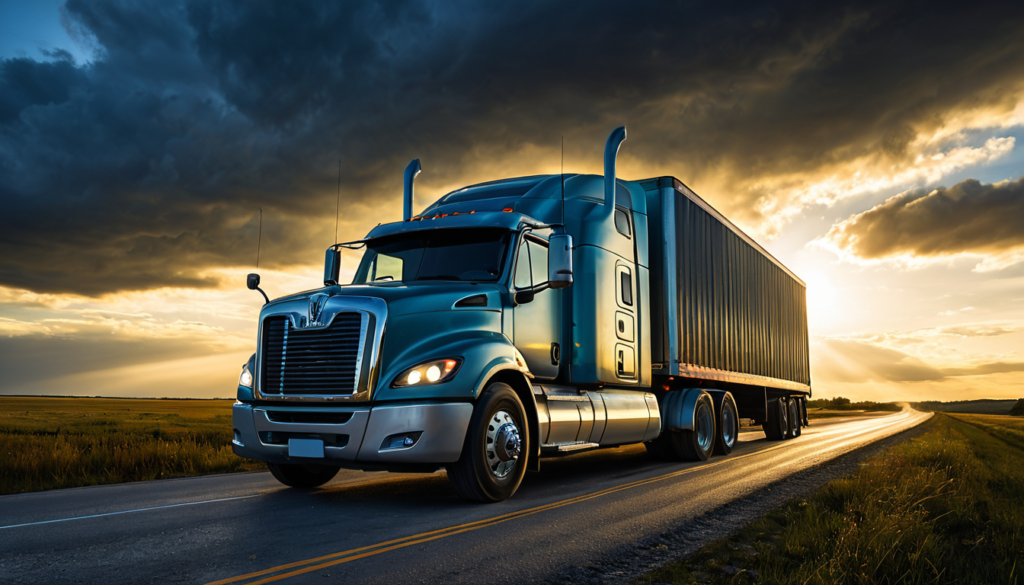
When an 80,000-pound truck slams into a passenger vehicle on the winding rural highways of Allamakee County, the physics alone guarantee catastrophe. Your sedan weighs roughly 4,000 pounds. That commercial vehicle outweighs you by twenty times. At 55 miles per hour on US-18 or US-52, the force released in a collision doesn’t just cause injuries—it shatters lives, families, and futures in an instant.
If you’re reading this from a hospital room in Waukon, Postville, or Lansing, or if you’re searching for answers after losing a loved one to a trucking accident anywhere in Allamakee County, you need to understand something critical: the trucking company already has lawyers working to protect them. They dispatched a rapid-response team before the ambulance left the scene. They’re preserving evidence—or worse, they’re letting it disappear. And Iowa law gives you just two years to file your claim, which sounds like a long time until you realize that black box data can be overwritten in thirty days.
We’re Attorney911, and we’ve spent over 25 years fighting for families devastated by 18-wheeler accidents. Ralph Manginello, our managing partner, has been standing up to trucking companies since 1998. He’s admitted to federal court, has gone toe-to-toe with Fortune 500 corporations like BP in the Texas City refinery explosion litigation, and has recovered multi-million dollar settlements for catastrophic injuries. Our associate attorney Lupe Peña used to defend insurance companies. Now he fights against them, bringing insider knowledge of exactly how these corporations minimize claims.
We’ve recovered over $50 million for clients nationwide, including a $5 million settlement for a traumatic brain injury victim struck by a falling log, a $3.8 million recovery for a client who suffered a partial leg amputation after a car accident, and we’re currently litigating a $10 million hazing lawsuit against the University of Houston that demonstrates our willingness to take on institutional defendants with deep pockets. But more importantly, we understand what you’re going through right now—the medical bills piling up, the lost wages, the uncertainty—and we know how to help.
Call us immediately at 1-888-ATTY-911. We answer 24/7, and if you speak Spanish, Lupe Peña is fluent and ready to help without interpreters. Hablamos Español.
Why Allamakee County Trucking Accidents Are Different
Every 16 minutes, someone in America is injured in a commercial truck crash. But here in Allamakee County, the risk factors multiply. We’re situated in the heart of agricultural Iowa, where grain haulers, livestock transports, and equipment carriers traverse US-18, US-52, and IA-76 daily. These aren’t just highways—they’re lifelines for the farming community, and they’re often plagued by conditions that make trucking accidents more likely and more deadly.
The geography works against safety. Allamakee County’s rolling hills and steep grades, particularly along the Mississippi River corridors and bluff country, create dangerous braking situations. In winter, Iowa’s notorious blizzards and black ice transform these rural roads into deathtraps. A truck driver unfamiliar with these conditions—or worse, pushing past federal hours-of-service limits to beat a storm—can jackknife on ice, spill cargo across a narrow county road, or lose control on a curve near the Yellow River State Forest.
Unlike urban areas with multiple trauma centers, Allamakee County residents often face long transport times to hospitals after serious crashes. That delay can worsen injuries and complicate immediate documentation. The trucking companies know this. They know that rural accidents often have fewer witnesses, slower police response times, and victims who are too injured or isolated to protect their own rights immediately.
That’s why you need a firm that understands both the local Allamakee County landscape and the complex federal regulations governing commercial trucking. We know these roads. We know the difference between a crash on a straight stretch of US-18 versus a rollover on the winding approaches to the Mississippi River bridges. And we know that every day you wait to call us, evidence critical to your case is disappearing.
The 48-Hour Evidence Race
Here’s what the trucking company doesn’t want you to know: the moment their driver calls dispatch, their defense begins. They have teams of lawyers and investigators whose sole job is to minimize what they pay you. And they know that in Iowa, the evidence you need to prove their negligence has a short shelf life.
That black box data—technically called the Engine Control Module or Electronic Logging Device—that records speed, braking, throttle position, and hours of service? It can be overwritten in as little as thirty days, sometimes sooner if the truck goes back into service. The dashcam footage showing the driver was texting or falling asleep? Often deleted within seven days. The driver’s qualification file, maintenance records, and pre-trip inspection logs? Federal regulations only require trucking companies to keep some of these records for six months to a year—unless a preservation letter locks them down.
We send spoliation letters within 24 hours of being retained. These aren’t polite requests—they’re legal notices that put the trucking company on notice that destroying evidence will result in serious sanctions, potentially including default judgment or punitive damages. We demand preservation of:
- ECM/EDR data showing exactly what the truck did in the seconds before impact
- ELD logs proving whether the driver violated federal hours-of-service regulations
- The complete Driver Qualification File, including background checks and medical certifications
- All maintenance and inspection records for the vehicle
- Cell phone records to prove distraction
- GPS and telematics data showing route history
- Dispatch communications and load documentation
If you’ve been hurt in an Allamakee County trucking accident, every hour you wait makes our job harder. Call 888-ATTY-911 now.
Federal Law vs. Local Roads: Understanding FMCSA Regulations
Commercial trucks don’t just follow Iowa state law—they’re governed by the Federal Motor Carrier Safety Administration (FMCSA) regulations found in Title 49 of the Code of Federal Regulations, Parts 390 through 399. These rules exist precisely because trucks are too dangerous to operate without strict oversight. When trucking companies break these rules—and they often do in rural areas where enforcement is spotty—they’re negligent, and you can hold them accountable.
49 CFR Part 391: Driver Qualification Standards
Trucking companies cannot legally hire just anyone with a commercial driver’s license. Under 49 CFR § 391.11, drivers must be at least 21 years old for interstate commerce, able to read and speak English sufficiently to understand traffic signs, physically qualified under § 391.41 (which disqualifies drivers with certain medical conditions), and possess a valid CDL. The company must maintain a Driver Qualification File containing employment applications, three years of driving history, annual driving record reviews, and medical examiner certificates.
We’ve seen cases where Allamakee County trucking accidents involved drivers with suspended licenses, uncontrolled sleep apnea, or histories of reckless driving that the company never bothered to check. That’s not just negligence—that’s potentially punitive damages territory.
49 CFR Part 392: Driving of Commercial Motor Vehicles
This section contains the rules of the road for truckers, and violations cause accidents. Under 49 CFR § 392.3, no driver shall operate a commercial motor vehicle “while the driver’s ability or alertness is so impaired, or so likely to become impaired, through fatigue, illness, or any other cause, as to make it unsafe.” This means both the driver and the company can be liable when a fatigued driver causes a crash.
Section 392.11 requires drivers to follow other vehicles at a safe distance—critical on icy Iowa roads where stopping distances triple. Section 392.82 prohibits hand-held mobile phone use while driving, and § 392.4 and § 392.5 forbid drug and alcohol use within four hours of duty.
49 CFR Part 393: Parts and Accessories for Safe Operation
This governs the truck itself. Brake systems must meet specific requirements under § 393.40-55. Cargo must be secured under § 393.100-136 with specific performance criteria: cargo securement systems must withstand 0.8 g deceleration forward, 0.5 g acceleration rearward, and 0.5 g lateral forces. When a grain hauler rolls over on a curve near Waterville because the load shifted, or when a flatbed drops equipment onto US-52 because of inadequate tiedowns, that’s a federal violation that proves negligence.
49 CFR Part 395: Hours of Service
This is the big one—the regulation broken most often and deadliest when violated. For property-carrying drivers (most 18-wheelers):
- 11-Hour Driving Limit: Cannot drive more than 11 hours after 10 consecutive hours off duty
- 14-Hour Window: Cannot drive beyond the 14th consecutive hour after coming on duty
- 30-Minute Break: Required after 8 cumulative hours of driving
- 60/70 Rule: Cannot drive after 60 hours in 7 days or 70 hours in 8 days without a 34-hour restart
Since December 18, 2017, most trucks must use Electronic Logging Devices (ELDs) to track these hours automatically. But paper logs still exist, and creative “bookkeeping” to hide hours is rampant in agricultural hauling where drivers feel pressure to move crops during narrow weather windows.
49 CFR Part 396: Inspection, Repair, and Maintenance
Trucking companies must systematically inspect and maintain their vehicles. Drivers must perform pre-trip inspections under § 396.13 and prepare written post-trip reports under § 396.11 documenting any defects in brakes, steering, lighting, tires, or coupling devices. When a tire blowout causes a rollover on IA-76 because the tread was worn below the 4/32″ minimum required by § 393.75, or when brake failure causes a runaway truck on a hill because the company deferred maintenance to save money, those records prove your case.
Types of 18-Wheeler Accidents in Allamakee County
Jackknife Accidents
When a truck’s trailer swings perpendicular to the cab, it creates a “V” shape that sweeps across all lanes. In Allamakee County, jackknifes often happen on US-18 or US-52 during winter storms when drivers brake improperly on ice, or when empty trailers—common in agricultural return runs—have less traction and are prone to swing. These accidents frequently involve multiple vehicles and result in catastrophic injuries when cars are crushed by the sliding trailer.
The data usually shows the driver was traveling too fast for conditions—a violation of 49 CFR § 392.6—or had defective brake systems under § 393.48. We subpoena the ECM data to prove exactly when and how hard the driver braked, and whether they were exceeding the 11-hour driving limit when they should have been resting.
Rollover Accidents
Allamakee County’s topography makes rollovers particularly dangerous. The steep grades leading down to the Mississippi River, the winding curves of the Driftless Area near the Wisconsin border, and the narrow shoulders of rural highways create perfect conditions for trucks to tip. Rollovers happen when drivers take curves too fast (violating § 392.6), when cargo shifts due to improper loading (violating § 393.100), or when drivers overcorrect after drifting.
These accidents often spill hazardous materials—grain dust, diesel fuel, or agricultural chemicals—onto county roads, creating secondary exposure risks. The injuries are crushing: traumatic brain injuries, spinal cord damage, and often fatalities for any vehicle caught beneath the falling trailer.
Underride Collisions
Perhaps the most horrific trucking accidents involve underride, where a smaller vehicle slides under the trailer, shearing off the roof and killing or decapitating the occupants. While federal law requires rear impact guards on trailers manufactured after January 26, 1998 (49 CFR § 393.86), these guards often fail in crashes above 35 mph, and there are no federal requirements for side underride guards—though many safety advocates are pushing for them.
On narrow Allamakee County roads, particularly at rural intersections where visibility is limited by hills or cornfields, passenger vehicles can easily slide under the side of a turning truck. These cases often involve both the trucking company and the trailer manufacturer, as we investigate whether the rear guards met standards or whether the company knowingly operated with deficient equipment.
Rear-End Collisions
An 80,000-pound truck traveling at 55 mph needs approximately 335 feet to stop—nearly the length of a football field. In bad weather on Iowa roads, that distance doubles. When a truck rear-ends a passenger vehicle, it’s usually because the driver was following too closely (violating § 392.11), was distracted by a phone (violating § 392.82), or was fatigued beyond the 11-hour limit (violating § 395).
The injuries in these accidents are severe: whiplash, traumatic brain injury from the violent acceleration, and spinal cord damage. We obtain cell phone records and ELD data to prove distraction or fatigue, and we analyze brake maintenance records to determine if the truck could have stopped if properly maintained.
Wide Turn Accidents (“Squeeze Play”)
Trucks making right turns off narrow county roads often swing left first to accommodate the trailer’s tracking, creating a gap that tempts drivers to pass on the right. When the truck completes its turn, it traps and crushes the vehicle. These accidents often happen at intersections in towns like Waukon or Postville, where the mix of rural highways and local traffic creates dangerous conflicts.
Drivers are required to signal their intentions and check blind spots. Failure to do so violates § 392.11 and state traffic laws. These cases often involve both the truck driver and the trucking company for negligent training—many drivers aren’t properly taught how to execute safe turns in rural environments.
Tire Blowouts and Brake Failures
On long hauls through Iowa’s hot summers and frigid winters, truck tires endure extreme stress. A blowout on US-52 can cause the driver to lose control, sending the truck into oncoming traffic or causing a rollover. Federal law requires minimum tread depths (4/32″ for steer tires, 2/32″ for others under § 393.75) and mandates pre-trip inspections under § 396.13.
Brake failures are even deadlier. Under § 393.40-55, trucks must have properly functioning service brakes on all wheels. When companies defer maintenance to save money—particularly on older trucks common in agricultural fleets—the result can be a runaway truck on a hill with no ability to stop before a collision.
Everyone Who Can Be Held Liable
Most people think you just sue the truck driver. That’s a mistake that costs victims millions. In 18-wheeler accidents, multiple parties share responsibility, and each represents a different insurance policy that can contribute to your recovery.
The Driver
Obviously, the person behind the wheel is responsible if they were speeding, distracted, fatigued, or impaired. We obtain their driving record, cell phone data, and medical certifications to prove they shouldn’t have been on the road.
The Trucking Company (Motor Carrier)
Under the doctrine of respondeat superior, employers are liable for their employees’ negligent acts. But we also pursue direct negligence claims:
- Negligent Hiring: Did they check the driver’s record? Did they know about prior DUIs or accidents?
- Negligent Training: Were drivers trained on winter weather operations? Do they know how to handle Jackknifing?
- Negligent Supervision: Did they monitor ELD data to catch hours-of-service violations?
- Negligent Maintenance: Did they skip brake inspections to keep trucks rolling during harvest season?
The Cargo Owner and Loading Company
In agricultural areas like Allamakee County, grain elevators and livestock operations often load trucks. If they overload the vehicle beyond capacity, fail to properly secure cargo, or create unbalanced loads that cause rollovers, they’re liable. We investigate bills of lading, loading procedures, and weight tickets.
The Truck and Parts Manufacturers
If the accident was caused by defective brakes, a steering system failure, or a tire blowout due to manufacturing defects, we pursue product liability claims against the manufacturers. These cases require expert mechanical analysis and review of recall histories.
The Maintenance Company
Third-party mechanics who performed inadequate repairs or failed to identify safety hazards can be liable. We obtain work orders and maintenance logs to determine what was missed.
The Freight Broker
Brokers who arrange transportation but don’t own the trucks may be liable for negligent selection—hiring a carrier with a poor safety record or inadequate insurance to save money.
Government Entities
If poor road design, inadequate signage on dangerous curves, or failure to maintain safe road conditions contributed to the accident, we may pursue claims against state or county governments—though Iowa’s sovereign immunity laws create strict notice requirements and damage caps that require immediate action.
Catastrophic Injuries and Real Case Values
We don’t handle fender-benders. We handle catastrophic injuries that change lives forever. In Allamakee County trucking accidents, we commonly see:
Traumatic Brain Injury (TBI)
The force of an 80,000-pound collision causes the brain to slam against the skull, resulting in concussions, contusions, or diffuse axonal injuries. Symptoms may not appear immediately—headaches, confusion, memory loss, personality changes, and depression can develop days or weeks later. Moderate to severe TBI cases typically settle in the $1.5 million to $9.8 million range depending on the need for lifelong care.
Spinal Cord Injury and Paralysis
When the spine is severed or compressed, the result is paraplegia (loss of use of legs) or quadriplegia (loss of use of all four limbs). These injuries require wheelchairs, home modifications, personal care assistance, and ongoing medical treatment. Settlement ranges often reach $4.7 million to $25.8 million.
Amputation
Crushing injuries in trucking accidents sometimes require surgical amputation of limbs. Even when limbs are severed traumatically at the scene, the long-term cost of prosthetics, rehabilitation, and disability accommodation is staggering. These cases range from $1.9 million to $8.6 million.
Wrongful Death
When a trucking accident kills a loved one, surviving family members can pursue wrongful death claims for lost income, loss of companionship, mental anguish, and funeral expenses. These cases range from $1.9 million to $9.5 million or higher depending on the decedent’s age, income, and family circumstances.
Client Glenda Walker told us after her settlement: “They fought for me to get every dime I deserved.” Chad Harris said: “You are NOT a pest to them and you are NOT just some client… You are FAMILY to them.” That’s how we treat every Allamakee County client—because we know you’re not just a case number, you’re a neighbor in crisis.
Iowa Law: What You Need to Know
Statute of Limitations
In Iowa, you have two years from the date of the accident to file a personal injury lawsuit (Iowa Code § 614.1). For wrongful death, the clock starts at the date of death. Wait longer, and you lose your rights forever—regardless of how serious your injuries or how clear the trucking company’s fault.
Comparative Fault: The 51% Bar
Iowa follows “modified comparative negligence” with a 51% bar (Iowa Code § 668.3). This means you can recover damages even if you were partially at fault, as long as you were 50% or less responsible. However, your recovery is reduced by your percentage of fault. If the trucking company convinces a jury you were 30% at fault for pulling out in front of them, you lose 30% of your verdict.
This is why immediate investigation is critical. We need to prove—through ECM data, ELD logs, and accident reconstruction—that the truck driver was primarily responsible. The trucking company will try to blame you. We make sure the data tells the truth.
Damage Caps
Unlike some states, Iowa does not cap compensatory damages in personal injury cases, including non-economic damages like pain and suffering. However, punitive damages are capped at the greater of three times compensatory damages or $500,000 (Iowa Code § 668A.1). Punitive damages require proving the defendant acted with “willful and wanton disregard for the rights or safety of another”—common in cases where trucking companies knowingly violated hours-of-service rules or hired drivers with dangerous histories.
What To Do Right Now
If you or a loved one was injured in an 18-wheeler accident anywhere in Allamakee County—from the Minnesota border to the Mississippi River, from New Albin to Harpers Ferry—here’s what you need to do immediately:
-
Seek Medical Attention – Even if you feel fine, adrenaline masks injuries. Traumatic brain injuries and internal bleeding may not show symptoms for days. Documentation links your injuries to the accident.
-
Preserve Evidence – Take photos of everything: the vehicles, the road conditions, weather, your injuries, the trucking company information (DOT number on the door), and witness contact information. If you’re unable, have a family member do this immediately.
-
Do Not Talk to the Trucking Company’s Insurance – They will ask for a recorded statement. Don’t give it. They are trained to get you to say things that hurt your case. Refer them to your attorney.
-
Call Attorney911 Immediately – The sooner we can send spoliation letters, the more evidence we can preserve. We work on contingency—you pay nothing unless we win. Call 1-888-ATTY-911 or 888-288-9911.
Frequently Asked Questions About Allamakee County Trucking Accidents
How long do I have to file a lawsuit after a trucking accident in Iowa?
You have two years from the date of the accident, or from the date of death in wrongful death cases. But waiting is dangerous. Evidence disappears, and the trucking company is building their defense right now. Call us immediately.
Can I still recover if I was partially at fault for the accident?
Yes, under Iowa’s comparative negligence law, as long as you were not more than 50% at fault. However, your recovery will be reduced by your percentage of fault. That’s why proving the truck driver violated FMCSA regulations is so important—it establishes their negligence outweighed any mistake you might have made.
What is a truck’s “black box” and why does it matter?
The Electronic Control Module (ECM) and Event Data Recorder (EDR) record speed, braking, throttle position, and other operational data. This objective evidence often contradicts the driver’s claims. But it can be overwritten in 30 days, which is why we must act fast to preserve it.
Who can be sued besides the truck driver?
The trucking company, cargo owner, loading company, truck manufacturer, parts manufacturers, maintenance companies, freight brokers, and potentially government entities if road conditions contributed. Each represents additional insurance coverage.
How much is my case worth?
It depends on your injuries, medical costs, lost wages, and the defendant’s insurance limits (typically $750,000 to $5 million for commercial trucks). We’ve recovered multi-million dollar settlements for catastrophic injuries, but every case is unique. Call for a free evaluation.
Do I have to pay upfront to hire you?
No. We work on contingency—33.33% pre-trial, 40% if we go to trial. You pay nothing unless we win. We advance all investigation costs.
What if the trucking company is from out of state?
Federal trucking laws apply nationwide, and we’re admitted to federal court. We can represent you regardless of where the trucking company is headquartered.
Hablamos Español. Llame al 1-888-ATTY-911.
Why Choose Attorney911 for Your Allamakee County Case
We’re not a billboard firm or a settlement mill. When you hire us, you get Ralph Manginello’s 25 years of experience, including his work on the BP Texas City refinery explosion that killed 15 workers and his current litigation of a $10 million lawsuit against the University of Houston. You get Lupe Peña, who spent years defending insurance companies and now uses that insider knowledge to fight for you. You get a firm with 251 Google reviews averaging 4.9 stars.
Most importantly, you get a team that treats you like family. As our client Kiimarii Yup said: “I lost everything… my car was at a total loss, and because of Attorney Manginello and my case worker Leonor, 1 year later I have gained so much in return plus a brand new truck.”
Donald Wilcox put it simply: “One company said they would not accept my case. Then I got a call from Manginello… I got a call to come pick up this handsome check.”
We take the cases other firms reject. We fight for the maximum recovery, not the quick settlement. And we don’t stop until justice is served.
Call 1-888-ATTY-911 (1-888-288-9911) now. We’re available 24/7, and your consultation is free. If you’ve been hurt by an 18-wheeler anywhere in Allamakee County, don’t wait another minute. The trucking company already has lawyers. You deserve a fighter in your corner.
Attorney911: Legal Emergency Lawyers™
Offices in Houston, Austin, and Beaumont, Texas, serving clients nationwide including Allamakee County, Iowa.