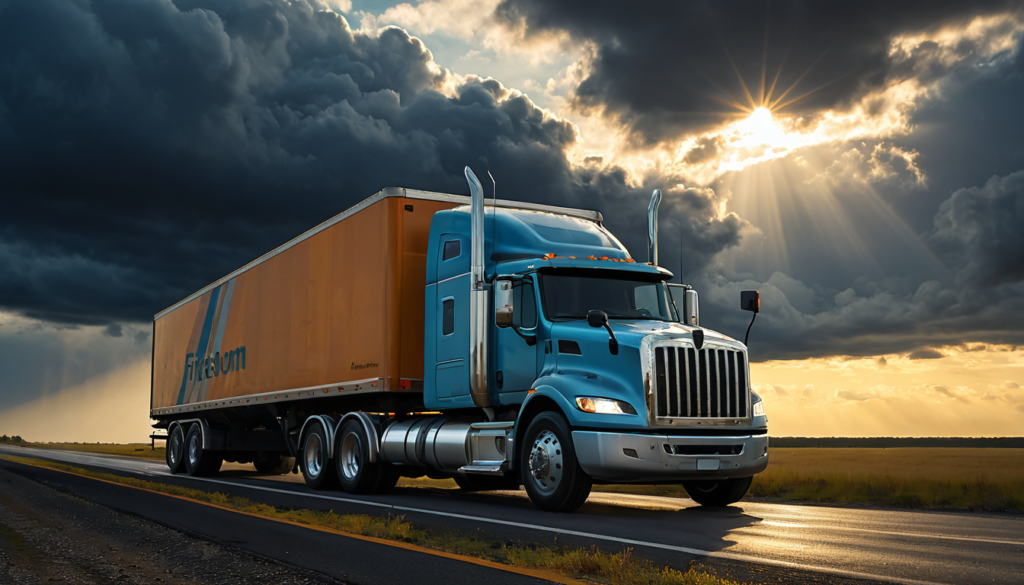
When an 80,000-pound tractor-trailer loses control on icy I-90 just outside Albert Lea, the physics are brutal. Twenty times heavier than your car. Forty percent longer stopping distance. And in Freeborn County, where winter storms sweep across the prairie and agricultural trucks haul tons of harvest produce year-round, these collisions happen fast—and they change lives forever.
If you’re reading this from a hospital bed in Freeborn County, or if you’re trying to help a loved one who’s been hurt, here’s what you need to know right now: the trucking company already called their lawyers. Their insurance adjuster is already looking for ways to pay you less. And critical evidence—black box data, driver logs, maintenance records—is disappearing every hour you wait.
We’re Attorney911. We’ve spent over 25 years fighting for trucking accident victims, and we’re here to help you fight back.
Why Freeborn County 18-Wheeler Accidents Are Different
There’s nothing “standard” about a collision with a commercial truck. A fully loaded semi can weigh up to 80,000 pounds under federal law. Your sedan weighs about 4,000 pounds. That’s not a fair fight—it’s a physics nightmare.
But Freeborn County presents unique dangers you won’t find in every jurisdiction. Our location at the intersection of I-90 and agricultural highways means heavy truck traffic mixing with rural roads. Winter weather here isn’t just inconvenient—it’s deadly. When temperatures drop to -20°F and black ice coats the highways, truck drivers who don’t adjust for conditions create catastrophic consequences.
Trucking companies know this. They carry $750,000 to $5 million in insurance coverage—far more than a typical car accident—because they know the damage their vehicles cause. But accessing that money requires understanding federal trucking regulations, Minnesota state law, and how to prove a trucking company broke the rules.
Our Promise to Freeborn County: Experience That Wins
When Ralph Manginello founded Attorney911 in 1998, he made a commitment: treat every client like family, and fight relentlessly for maximum recovery. That’s not just marketing—that’s exactly what our clients say about us.
Ralph brings more than 25 years of courtroom experience to your case. He’s admitted to the U.S. District Court for the Southern District of Texas, giving him federal jurisdiction when trucking cases cross state lines. He’s litigated against Fortune 500 companies like BP in the Texas City Refinery explosion that killed 15 workers and injured 170 more. He’s currently fighting a $10 million hazing lawsuit against the University of Houston and Pi Kappa Phi fraternity—a case that demonstrates we don’t back down from powerful institutions.
But here’s what really matters for your Freeborn County case: our team includes Lupe Peña, a former insurance defense attorney who used to work for the very companies we’re fighting now. He knows their playbook. He knows how adjusters are trained to minimize your claim, when they’re bluffing, and exactly what it takes to make them pay fair value.
“Lupe knows the commercial trucking industry’s tactics—because he worked for them,” Ralph says. “Now he uses that insider knowledge to level the playing field for our clients.”
That’s your advantage. While you’re healing, we’re sending spoliation letters to preserve critical evidence before the trucking company can destroy it. While you’re dealing with medical bills, we’re analyzing Electronic Logging Device (ELD) data to prove the driver violated Hours of Service regulations. And when the insurance company makes their first lowball offer—which they always do—we’re preparing to take your case to trial if that’s what justice requires.
As client Chad Harris told us: “You are NOT a pest to them and you are NOT just some client… You are FAMILY to them.”
Minnesota Law: What Freeborn County Victims Need to Know
In Minnesota, you have two years from the date of the accident to file a personal injury lawsuit. For wrongful death claims, you have three years from the date of death. That sounds like plenty of time, but here’s the truth: waiting even a week can destroy your case.
Trucking companies must preserve Electronic Control Module (ECM) data and ELD records for only six months under federal regulations. But ECM data—the “black box” that records speed, braking, and engine performance—can be overwritten in as little as 30 days if the truck continues operating. Witnesses forget details. Dashcam footage gets deleted. And the trucking company’s rapid-response team is already at the accident scene, taking photos and statements to protect their interests.
Freeborn County operates under Minnesota’s modified comparative negligence rule. You can recover damages as long as you’re not more than 50% at fault for the accident. If you’re partially responsible, your recovery is reduced by your percentage of fault. But if the trucking company can convince a jury you were 51% responsible, you recover nothing. That’s why evidence preservation and aggressive investigation matter from day one.
Unlike some states, Minnesota does not cap punitive damages. When a trucking company shows gross negligence—like knowingly putting a fatigued driver on the road or falsifying maintenance records—we can pursue additional damages to punish their misconduct. Recent “nuclear verdicts” across the country show juries are willing to award tens of millions when trucking companies prioritize profit over safety.
The Physics of Devastation: How 18-Wheeler Accidents Happen in Freeborn County
Freeborn County’s geography creates specific risks. We’re an agricultural hub—Corn, soybeans, and livestock move through here constantly. During harvest season, truck traffic spikes. In winter, I-90 becomes a treacherous corridor where blowing snow and black ice lead to chain-reaction pileups.
Here are the accident types we see most often in Freeborn County, and the federal regulations trucking companies violate to cause them:
Jackknife Accidents
When a truck driver brakes too hard on slick pavement—especially common on I-90 and Highway 65 during Freeborn County’s harsh winters—the trailer swings out perpendicular to the cab, sweeping across all lanes. These accidents often trigger multi-vehicle pileups.
The Regulation: 49 CFR § 392.6 prohibits operating at speeds unsafe for conditions. When a driver fails to reduce speed on icy roads and jackknifes, they’re violating federal law. Additionally, 49 CFR § 393.48 requires properly maintained brake systems. If brake imbalance caused the jackknife, we’ll find it in the maintenance records.
Rear-End Collisions
An 80,000-pound truck traveling at 65 mph needs 525 feet to stop—nearly two football fields. In Freeborn County traffic, following too closely is deadly.
The Regulation: 49 CFR § 392.11 requires drivers to maintain “reasonable and prudent” following distances. When ELD data shows a truck was following too closely, or when ECM data reveals the driver never braked before impact, we have proof of negligence.
Rollover Accidents
Top-heavy loads and sharp curves don’t mix—especially when truck drivers take Freeborn County’s rural roads too fast or when improperly secured cargo shifts.
The Regulation: 49 CFR § 393.100-136 mandates specific cargo securement standards. Cargo must withstand 0.8g deceleration forward and 0.5g lateral movement. When loading companies cut corners or drivers fail to inspect securement, rollovers happen. The trucking company and cargo loader may both be liable.
Underride Collisions
When a passenger vehicle slides under the trailer of a semi-truck—often during sudden stops on I-90—the roof of the car gets sheared off. These are almost always fatal or result in catastrophic head trauma.
The Regulation: 49 CFR § 393.86 requires rear impact guards on trailers manufactured after January 26, 1998. But guards can be damaged, poorly maintained, or absent entirely. Side underride guards aren’t federally mandated yet, but we pursue claims against trucking companies who knew these guards save lives and refused to install them.
Tire Blowouts and Brake Failures
Extreme temperature swings in Freeborn County—from summer heat to winter cold—stress truck tires. Poor maintenance practices lead to blowouts that cause drivers to lose control.
The Regulation: 49 CFR § 396.3 requires systematic inspection and maintenance. Drivers must complete pre-trip inspections covering tires, brakes, and safety equipment. When companies defer maintenance to save money, they create deadly hazards. Brake problems contribute to approximately 29% of large truck crashes, yet 49 CFR § 393.40-55 mandates specific brake system requirements that companies often ignore.
Driver Fatigue Accidents
Freeborn County sits on major east-west freight corridors. Truckers push through Minnesota on long hauls, often violating Hours of Service rules to meet delivery deadlines.
The Regulation: 49 CFR § 395 limits property-carrying drivers to 11 hours of driving after 10 consecutive hours off duty. They cannot drive beyond the 14th consecutive hour after coming on duty. When our team analyzes ELD data and finds violations—or discovers falsified logbooks—we prove the driver was too tired to safely navigate Freeborn County’s roads.
Every Party Who Might Owe You Money
Most law firms only sue the truck driver and maybe the trucking company. That’s leaving money on the table. Under Minnesota law and federal regulations, ten different parties might be liable for your injuries:
-
The Truck Driver: For speeding, distraction, fatigue, or impairment (49 CFR § 392.3 prohibits operating while fatigued; § 392.82 bans hand-held mobile phone use).
-
The Trucking Company: Under respondeat superior, employers are responsible for employees’ negligence. Plus, they face direct liability for negligent hiring (49 CFR § 391.51 requires Driver Qualification Files), negligent training, and negligent supervision.
-
The Cargo Owner/Shipper: If they demanded overweight loading or pressured unsafe delivery schedules.
-
The Loading Company: For improperly secured cargo violating 49 CFR § 393.100.
-
The Truck Manufacturer: For defective brakes, tires, or stability control systems.
-
The Parts Manufacturer: When specific components like brake chambers or tire treads fail.
-
The Maintenance Company: For negligent repairs that missed critical safety issues.
-
The Freight Broker: For negligent selection of carriers with poor safety records.
-
The Truck Owner (if different from the carrier): For negligent entrustment or failure to maintain equipment.
-
Government Entities: If dangerous road design or inadequate signage on Freeborn County roads contributed to the crash.
We investigate all of them. Why? Because more defendants mean more insurance coverage, and more coverage means you get the compensation you actually need—not just what one policy will pay.
The Evidence That Wins Cases (And Why You Must Act Now)
The trucking industry knows evidence is their enemy. That’s why they deploy “rapid response teams” to accident scenes within hours—sometimes before the ambulance leaves. They’re collecting evidence to protect themselves.
Here’s what we need to secure immediately—the 48-hour evidence protocol:
Electronic Control Module (ECM) Data: Records speed, braking, throttle position, and fault codes. Overwrites in 30 days or with new driving events.
Electronic Logging Device (ELD) Data: Proves Hours of Service violations. Required since December 18, 2017. Shows exactly how long the driver was on duty.
Driver Qualification File: Employment applications, background checks, medical certifications, drug tests, and training records. If the trucking company hired a driver with a history of violations or failed to check his record, that’s negligent hiring.
Maintenance Records: Brake inspections, tire replacements, and repair logs. 49 CFR § 396.3 requires systematic maintenance. When companies skip inspections to keep trucks rolling, we find the proof.
Drug and Alcohol Test Results: Federal law requires testing after accidents involving fatalities or injuries requiring immediate medical attention away from the scene.
Cell Phone Records: Proves distracted driving if the driver was texting or calling at the time of impact.
Surveillance Footage: Traffic cameras, nearby businesses, or dashcams that captured the collision.
We send spoliation letters within 24 hours of being retained. These legal notices put the trucking company on notice that destroying evidence will result in sanctions, adverse jury instructions, or default judgment. But we can’t send those letters until you call us.
Catastrophic Injuries: When “Recovery” Means “Learning to Live Again”
We don’t handle fender-benders. We handle catastrophic injuries that alter the trajectory of entire families. The physics of an 80,000-pound truck versus a 4,000-pound car means:
Traumatic Brain Injuries (TBI): From concussions to permanent cognitive impairment. Lifetime care costs can exceed $3 million. We’ve secured settlements ranging from $1.5 million to $9.8 million for TBI victims.
Spinal Cord Injuries: Paraplegia or quadriplegia requiring lifelong care. First-year costs alone can reach $1 million; lifetime costs exceed $5 million for quadriplegia.
Amputations: Whether traumatic (severed at the scene) or surgical (due to crush injuries), prosthetics require replacement every few years at $5,000 to $50,000 each.
Severe Burns: From fuel tank ruptures or hazmat spills. Multi-layer skin grafts, infection risks, and permanent disfigurement.
Wrongful Death: When Freeborn County families lose a loved one, we pursue claims for lost income, loss of companionship, mental anguish, and funeral expenses. Our wrongful death settlements range from $1.9 million to $9.5 million.
As client Kiimarii Yup said after we helped him rebuild his life following a devastating truck accident: “I lost everything… my car was at a total loss, and because of Attorney Manginello and my case worker Leonor, 1 year later I have gained so much in return plus a brand new truck.”
And Glenda Walker told us: “They fought for me to get every dime I deserved.”
That’s what we do. We don’t just settle—we maximize.
Insurance Coverage: Why Trucking Cases Are Worth More
Federal law requires commercial trucking companies to carry substantial liability coverage:
- $750,000 for general freight (non-hazardous)
- $1,000,000 for oil, petroleum, and large equipment transport
- $5,000,000 for hazardous materials and passenger transport
Many carriers carry $1 million to $5 million in coverage, sometimes with excess umbrella policies. This is why trucking accident settlements often dwarf car accident settlements—there’s actually money available to pay for your catastrophic injuries.
But the insurance company won’t offer it voluntarily. Their playbook, as Lupe Peña knows from his years inside the industry, includes:
- Quick lowball settlements before you know the full extent of your injuries
- Recorded statements designed to trick you into admitting fault
- Surveillance investigators filming you to claim you’re “not really injured”
- Delay tactics hoping you’ll accept less out of desperation
We don’t let them get away with it. Because we prepare every case for trial, insurance companies know we’ll go to court if they don’t pay fair value. That willingness to try cases creates leverage that gets you better settlements faster.
What to Do After an 18-Wheeler Accident in Freeborn County
If you’re able to act immediately after the crash:
-
Call 911. File a police report. Get the officer’s name and badge number.
-
Seek medical attention immediately. Even if you feel “okay,” adrenaline masks injuries. Freeborn County Medical Center or surrounding trauma centers can diagnose internal injuries before they become life-threatening.
-
Document everything. Photo the truck’s DOT number (usually on the door), license plates, all vehicles involved, road conditions, and your injuries. Take more photos than you think you need.
-
Get witness information. Independent witnesses are invaluable. Get names and phone numbers.
-
Do NOT give recorded statements. The trucking company’s insurance adjuster is not your friend. Anything you say will be used against you.
-
Call Attorney911 immediately. 1-888-ATTY-911. We answer 24/7.
Minnesota’s statute of limitations gives you two years, but waiting is dangerous. Evidence disappears. Memories fade. And the trucking company is already building their defense.
Frequently Asked Questions for Freeborn County Victims
How much is my 18-wheeler accident case worth?
Every case is unique. Factors include injury severity, medical costs, lost wages, pain and suffering, and available insurance. We’ve recovered multi-million dollar settlements for clients, including $5 million for a traumatic brain injury victim and $3.8 million for a client who suffered amputation after a crash.
Should I talk to the trucking company’s insurance adjuster?
No. Never give a recorded statement without an attorney present. As client Donald Wilcox learned: “One company said they would not accept my case. Then I got a call from Manginello… I got a call to come pick up this handsome check.” Let us handle the communications.
What if the accident was partially my fault?
Under Minnesota’s comparative fault rules, you can recover as long as you’re not more than 50% responsible. Your recovery is reduced by your percentage of fault—but you can still get justice.
How long will my case take?
Complex trucking cases with catastrophic injuries often take 12 to 36 months. We work as fast as possible while ensuring we capture all your damages—including future medical needs you might not anticipate yet.
Can I afford an attorney?
Yes. We work on contingency—you pay nothing unless we win. We advance all costs for investigation and expert witnesses. There’s no hourly billing. As Jacqueline Johnson said in her review: “One of Houston’s Great Men Trae Tha Truth has recommended this law firm. So if he is vouching for them then I know they do good work.”
Do you speak Spanish?
Yes. Lupe Peña is fluent in Spanish. Hablamos Español. Llame al 1-888-ATTY-911 para una consulta gratis.
What if the trucking company claims the driver was an independent contractor?
We investigate the relationship. If the company controlled the driver’s schedule, routes, or equipment, they may still be vicariously liable. Additionally, we pursue the trucking company for negligent hiring or entrustment regardless of employment status.
What if my loved one died in the accident?
We’re deeply sorry for your loss. Wrongful death claims in Minnesota allow recovery for funeral expenses, lost income, loss of consortium, and mental anguish. We handle these cases with compassion while aggressively pursuing accountability.
Will my case go to trial?
Most cases settle, but we prepare every one for trial. Angel Walle, another client, told us: “They solved in a couple of months what others did nothing about in two years.” Whether through settlement or verdict, we fight for maximum compensation.
Your Next Step: Call Attorney911 Today
The trucking company has lawyers working right now to minimize your claim. You deserve someone fighting just as hard for you.
Ralph Manginello has spent over 25 years standing up to trucking companies, insurance giants, and corporate defendants. From the BP explosion litigation to the current $10 million University of Houston hazing case, he’s proven he won’t back down when justice is on the line.
Lupe Peña brings insider knowledge from his years defending insurance companies—knowledge he now uses to fight for you.
Together, they’ve recovered over $50 million for Texas and Minnesota families. They’ve earned a 4.9-star rating from 251+ Google reviews. And they’re ready to fight for you.
Call 1-888-ATTY-911 now. We answer 24/7. Consultations are free. You pay nothing unless we win.
Don’t let the trucking company push you around. Don’t accept a settlement that won’t cover your future medical bills. And don’t wait until evidence disappears.
Hablamos Español. Your fight starts now: 1-888-ATTY-911.