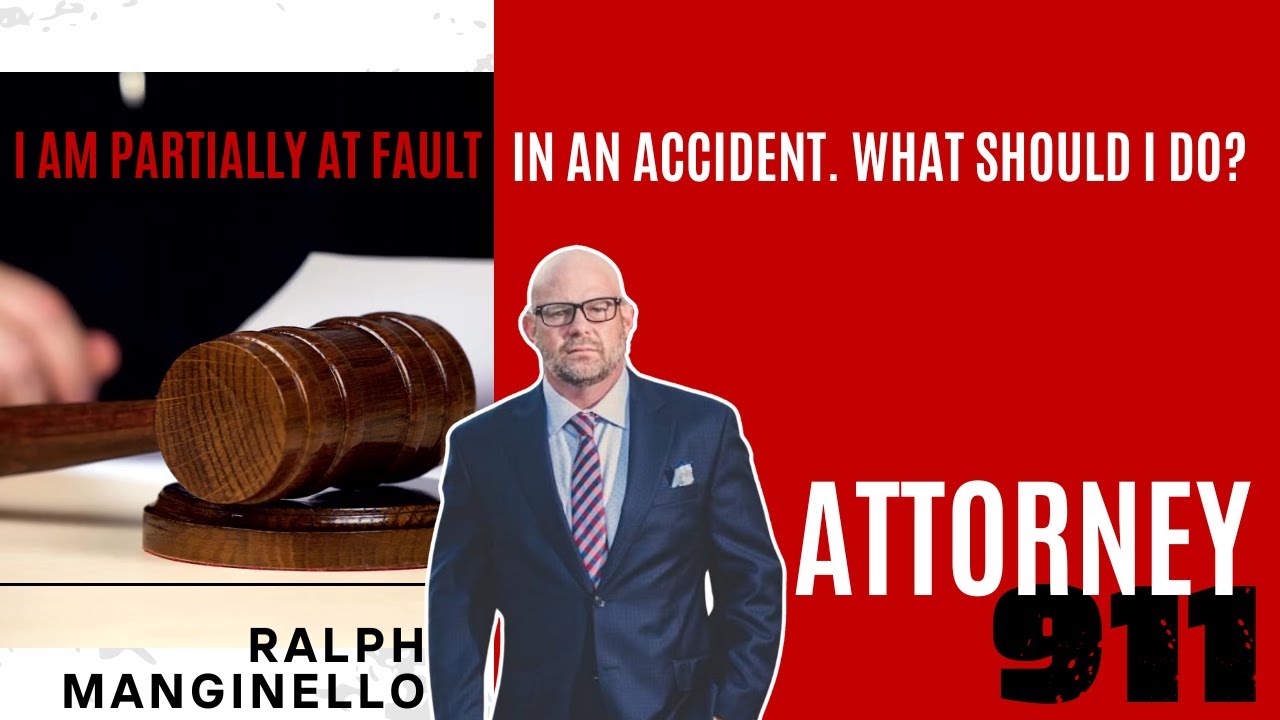
📹 Watch the Highlight
🎬 Watch the Full Video
“I’m Partially at Fault in an Accident”: Your Guide to Texas Comparative Negligence
If you’ve been in a car accident in Houston, Austin, Beaumont, or anywhere else in Texas, and you’re worried that you might bear some responsibility, you’re not alone. One of the most common and anxiety-inducing questions we hear at Attorney911 is, “What happens if I was partially at fault?” The insurance adjuster for the other driver might be calling you, suggesting you were 20%, 30%, or even 50% responsible for the collision. They use this to immediately slash the value of your claim, hoping you’ll accept a fraction of what your case is truly worth. As Attorney Ralph Manginello explains in his podcast, if they offer $10,000 but claim you’re 20% at fault, they’ll try to pay only $8,000. This is the reality of Texas’s comparative fault system, and understanding it is the difference between being taken advantage of and receiving full and fair compensation for your injuries, medical bills, and suffering. With over 25 years of experience handling complex personal injury cases across Texas, Ralph Manginello and our team at Attorney911—”Legal Emergency Lawyers™”—are here to demystify this process, expose the insurance tactics, and fight for what you deserve. If you’re facing this situation, call our legal emergency line now at 1-888-ATTY-911.
The Immediate Reality: Insurance Companies Use Fault to Undervalue You
From the moment an accident report is filed, the other driver’s insurance company begins building a case against you. Their goal is not to find the truth, but to minimize their payout. Assigning you a percentage of fault is their primary tool. As Ralph noted, they might say, “We would normally pay $10,000, but since your client’s 20% responsible, we’re only going to pay $8,000.” This initial offer is almost always a lowball, based on a fault percentage they’ve inflated. They bank on your fear, confusion, and lack of legal knowledge. What they don’t want you to know is that Texas follows a “modified comparative fault” rule with a 51% bar. This means you can recover damages as long as you are not more than 50% responsible for the accident. If you are 50% or less at fault, your recovery is reduced by your percentage of responsibility. But if you are found 51% or more at fault, you recover nothing. This is codified in the Texas Civil Practice & Remedies Code § 33.001. The fight, therefore, is often over that percentage. Our firm, with its insider advantage from former insurance defense attorney Lupe Peña, knows exactly how these percentages are calculated and how to challenge them aggressively.
Texas Comparative Negligence: A Deep Legal Dive
Texas hasn’t always used a comparative fault system. For decades, we followed the harsh “contributory negligence” doctrine, where if you were even 1% at fault, you were barred from any recovery. The law evolved to recognize that life—and accidents—are rarely black and white. The current system, adopted in the 1970s, aims to apportion financial responsibility based on each party’s degree of fault. However, this legal nuance becomes a weapon in the hands of insurance adjusters who are trained to shift blame onto victims.
How Fault is Determined: It’s a Negotiation, Not a Science
The percentage an insurance company throws out in their first offer is not a final judgment. It’s an opening bid in a high-stakes negotiation. The true determination of fault is a complex process that involves:
- Evidence Analysis: Police reports (which are often incomplete or contain errors), witness statements, photographs of the scene and vehicles, traffic camera or surveillance footage (which often gets deleted after 30 days), and event data recorder (“black box”) information.
- Traffic Laws: Violations of the Texas Transportation Code, such as speeding, failure to yield, or running a red light, are critical. In Ralph’s example, the driver turning right might have failed to yield, but the other driver speeding at 45 mph in a 30 mph zone also violated the law.
- Investigation: This is where having a law firm with resources matters. We conduct our own independent investigations, sometimes hiring accident reconstruction experts to analyze skid marks, vehicle damage, and physics to establish the sequence of events.
At Attorney911, we don’t accept the insurance company’s fault assignment. We build a counter-narrative. Lupe Peña’s years on the defense side taught him how insurers build these fault arguments, and now he uses that knowledge to dismantle them. For instance, he knows they will scour your social media for posts that could be misconstrued, or take recorded statements hoping you’ll admit to something harmless that they can twist. We protect you from these traps.
From Settlement Negotiation to the Courtroom: Fault Follows You
As Ralph Manginello emphasized, the issue of comparative fault doesn’t go away. It permeates every stage of your claim.
The Settlement Phase: The Battle Over Percentages
In negotiations, our job is to argue your percentage down and the overall value of your case up. The insurance company uses software like Colossus to generate lowball settlement ranges. Having Lupe, who used to work with these systems, is an unparalleled advantage. He understands the levers and inputs that can change the output. We fight with evidence. For example, in a case where our client was t-boned but the insurer claimed he was 30% at fault for “rolling” a stop sign, we obtained surveillance footage from a nearby store that clearly showed he came to a complete stop. The offer increased by over 40% once we presented that evidence.
At Trial: The Jury’s Final Say
If a fair settlement cannot be reached, we prepare your case for trial. As Ralph explained, the jury is given a charge with questions about each party’s negligence and a blank for a percentage. “Those percentages have to equal 100,” he said. The jury’s determination is final. If they find you 25% at fault, your verdict is reduced by that amount. This is why hiring a trial-tested firm is critical. Insurance companies know which firms are willing to go to trial and which will settle cheap to avoid the courtroom. At Attorney911, we prepare every case as if it’s going to trial. Our record of success, including taking on billion-dollar corporations in the BP Texas City explosion litigation, sends a clear message: we are not bluffing. This posture alone often leads to better settlement offers before a trial is even necessary.
Real-World Examples from Our Texas Courtrooms
The theoretical becomes real through case results. At Attorney911, we have successfully navigated comparative fault challenges to secure life-changing compensation for our clients.
Case Study: The Complex Multi-Vehicle Pileup
We represented a client involved in a catastrophic chain-reaction crash on I-10 in Houston. Multiple vehicles were involved, and the initial police report placed some blame on our client for following too closely. The insurance companies for the other drivers formed a united front, attempting to assign him 60% fault—which would have barred any recovery under Texas law. Our team, led by Ralph Manginello, launched a full-scale investigation. We hired an accident reconstruction expert who used drone footage and vehicle computer data to prove that our client had been safely following distance until a box truck three cars ahead made an illegal lane change and lost its load, triggering the crash. We demonstrated that the trucking company’s negligence was the primary cause. Through relentless litigation and leveraging Ralph’s federal court experience (U.S. District Court, Southern District of Texas), we shifted the fault narrative. The case settled for a confidential multi-million dollar amount, ensuring our client’s future medical care and financial security were covered.
Documented Results: How We Turn the Tide
Our firm’s database includes numerous victories where fault was contested:
- Logging Brain Injury: “Multi-million dollar settlement for client who suffered brain injury with vision loss when log dropped on him at logging company.” In this case, the defense argued our client was partially responsible for not being in a safe zone. We proved the company’s safety protocols were grossly inadequate.
- Car Accident Amputation: “In a recent case, our client’s leg was injured in a car accident. Staff infections during treatment led to a partial amputation. This case settled in the millions.” The other driver claimed our client swerved into his lane. Our investigation of the vehicle’s onboard diagnostics proved the other driver was distracted and crossed the center line.
- Maritime Back Injury: “In a recent case, our client injured his back while lifting cargo on a ship. Our investigation revealed that he should have been assisted in this duty, and we were able to reach a significant cash settlement.” The employer tried to claim he was negligent in his lifting technique. We proved the employer violated its own safety manual by having him work alone.
These results aren’t just numbers; they represent families in Houston, Austin, and Beaumont who were able to move forward because we fought the fault argument and won.
Why Attorney911’s Approach Is Different: The Insider Advantage
Most personal injury firms just react to insurance offers. We proactively deconstruct them because we have a secret weapon: Associate Attorney Lupe Peña, a former insurance defense attorney for a national firm. Lupe spent years on the other side, learning the exact playbook now being used against you. He knows how claims are valued, how adjusters are trained to secure recorded statements, which IME (Independent Medical Exam) doctors are hired to minimize injuries, and how surveillance is deployed. Now, he uses that insider knowledge exclusively for injured Texans.
As Lupe often says, “I’ve reviewed hundreds of surveillance videos and social media posts as a defense attorney. Here’s the truth: Insurance companies take innocent activity out of context. They freeze ONE frame of you moving ‘normally’ and ignore the 10 minutes of you struggling before and after. They’re not documenting your life—they’re building ammunition against you.” This perspective allows us to advise clients proactively, protecting their claims from day one.
Client Testimonials: Proof of Our Commitment
Our clients’ words speak volumes about our fight against unfair fault assignments:
- Donald Wilcox: “One company said they would not accept my case. Then I got a call from Manginello…I got a call to come pick up this handsome check.”
- Tracey White: “She had received an offer but she told me to give her one more week because she knew she could get a better offer.” This refers to our paralegal Leo fighting for every dollar.
- Greg Garcia: “In the beginning I had another attorney but he dropped my case although Manginello law firm were able to help me out.” We take cases other firms abandon.
- Jamin Marroquin: “Mr. Manginello guided me through the whole process with great expertise…tenacious, accessible, and determined throughout the 19 months.” This reflects Ralph’s 25+ years of hands-on leadership.
With over 251 Google reviews averaging 4.9 stars, the consensus is clear: we communicate, we fight, and we get results. Even Houston legend Trae Tha Truth has recommended our firm, a testament to our standing in the community.
What to Do Right Now If You Think You’re Partially at Fault
- STOP Talking to the Other Insurance Company: Do not give a recorded statement. Do not agree to their fault percentage. Anything you say will be used to reduce your claim.
- Preserve Evidence: Take photos of everything—the vehicles, the scene, your injuries. Get contact info for witnesses. If there are nearby businesses, note they might have surveillance footage (which often auto-deletes in 30 days).
- Seek Medical Attention: Your health is paramount. Some injuries, like traumatic brain injuries or soft tissue damage, have delayed symptoms. A medical record creates a documented link between the accident and your injuries.
- Contact Attorney911 Immediately: The sooner we get involved, the sooner we can protect you. We can send evidence preservation letters, launch our investigation, and deal with the adjusters so you can focus on healing. Remember, we work on a contingency fee—you pay nothing unless we win your case. Call 1-888-ATTY-911 for your free, no-obligation consultation. Hablamos Español.
Frequently Asked Questions About Partial Fault in Texas
Can I still recover money if I was 50% at fault?
Yes. Under Texas’s modified comparative fault rule (51% bar), you can recover damages if you are 50% or less at fault. Your recovery will be reduced by your percentage of responsibility. So, if a jury awards $100,000 and finds you 50% at fault, you would receive $50,000.
What if the insurance company says I’m 60% at fault?
Do not accept their assessment. This is a common tactic to scare you into dropping your claim or accepting a lowball settlement. Their initial percentage is a negotiating position, not a legal finding. We have successfully fought and reduced fault percentages assigned by insurance companies in countless cases.
How is fault percentage determined if my case goes to trial?
The jury decides. After hearing all the evidence, the judge will provide them with a “jury charge” that includes questions about each party’s negligence. The jury assigns percentages that must total 100%. Their decision is based on the preponderance of the evidence (what is more likely than not).
Does partial fault affect a wrongful death claim?
Yes. The same comparative fault rules apply. If a deceased family member was partially at fault, the compensation recovered by the surviving family in a wrongful death lawsuit would be reduced by their percentage of fault. Our firm has helped families in trucking-related wrongful death cases recover millions of dollars despite fault disputes.
What if the accident was mostly my fault but I was badly hurt?
If you are 51% or more at fault under Texas law, you cannot recover damages from the other party. However, you may still have options through your own insurance policy, such as Personal Injury Protection (PIP) or MedPay coverage. It is critical to have an attorney review your policy and the facts immediately. Call us at 1-888-ATTY-911 to explore all avenues.
Why should I choose Attorney911 over another firm?
Our combination of Ralph Manginello’s 25+ years of trial experience, including federal court and BP explosion litigation, and Lupe Peña’s insider insurance defense knowledge is unique. We don’t just process claims; we litigate cases. We prepare every case for trial, which forces insurance companies to offer more. Our multi-million dollar results and hundreds of 5-star reviews from clients across Houston, Austin, and Beaumont prove our commitment. You are not just a case file; you are family. Let us prove it to you.
Don’t Let an Insurance Adjuster Decide Your Future
Being partially at fault in an accident doesn’t mean you forfeit your right to compensation. It means the fight for fair compensation just became more complex. You need a Texas law firm with the experience, resources, and insider knowledge to fight that battle effectively. At Attorney911, we have taken on some of the largest insurance companies and corporations in the world and won. We are currently litigating a $10 million lawsuit against the University of Houston and a fraternity, demonstrating our willingness to fight powerful institutions. Whether your accident happened in Houston, Austin, Beaumont, or anywhere in between, we are here to help. The clock is ticking on evidence and the two-year statute of limitations. Protect your rights today. Call the legal emergency lawyers at 1-888-ATTY-911 or visit attorney911.com. Your first consultation is free, and there is no fee unless we win your case.
Frequently Asked Questions
Can I still recover money if I was 50% at fault in a Texas accident?
Yes. Texas uses a ‘modified comparative fault’ system with a 51% bar. If you are 50% or less at fault, you can recover damages, but your compensation will be reduced by your percentage of responsibility. For example, a $100,000 award with 50% fault yields $50,000.
What should I do if the insurance company says I’m mostly at fault?
Do not accept their assessment. This is a common pressure tactic. Immediately stop communicating with them and contact an experienced personal injury attorney. At Attorney911, we investigate aggressively to challenge inflated fault percentages and fight for a fair appraisal of liability.
How is fault percentage decided if my case goes to trial in Texas?
A jury determines fault percentages at trial. After hearing all evidence, the judge gives them a ‘jury charge’ with questions about each party’s negligence. The jury assigns percentages that must total 100%. Their verdict is then reduced by your assigned percentage.
Does partial fault affect a wrongful death claim in Texas?
Yes, the same comparative fault rules apply. If the deceased was partially at fault, the compensation recovered by the family in a wrongful death lawsuit is reduced by that percentage. Our firm has secured multi-million dollar recoveries for families in wrongful death cases despite fault disputes.
Why is Attorney911 uniquely equipped to handle partial-fault accident cases?
We combine Ralph Manginello’s 25+ years of trial experience with Lupe Peña’s insider knowledge as a former insurance defense attorney. We know how insurers build fault arguments and how to dismantle them. Our track record includes multi-million dollar settlements in complex liability cases.
What if the accident was mostly my fault but I have severe injuries?
If you are 51% or more at fault under Texas law, you cannot recover from the other driver. However, you may have claims under your own insurance policy (PIP, MedPay, UM/UIM). It’s crucial to have an attorney review your options. Call 1-888-ATTY-911 for a free case evaluation.